 Skip to main content


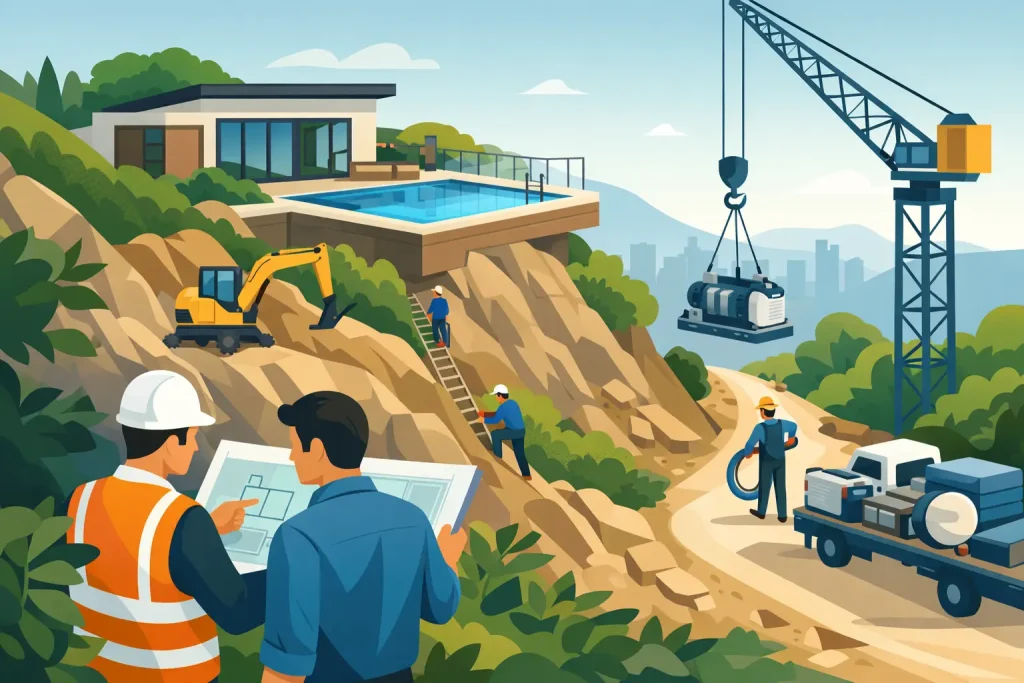
A difficult access pool project usually starts with a block that looks great on paper and far less simple in person. Narrow side access, steep gradients, retaining walls, established landscaping, overhead wires, tight inner-suburban lots or limited room for excavation equipment can all change how a pool needs to be designed and built. The good news is that difficult access does not automatically mean impossible. It means the project needs the right construction method, realistic planning and a builder who knows how to work with the site rather than against it.
For many Melbourne homeowners, access is one of the biggest concerns early on. People often assume a pool can only be built if a large excavator can drive straight into the backyard. That is not always the case. Modern pool construction methods, particularly lightweight panel-built systems, have opened up practical options for sites that would be expensive, disruptive or simply unworkable with more traditional approaches.
What makes a difficult access pool project difficult?
Access issues come in different forms, and each one affects the build in a different way. On some sites, the challenge is physical width. A standard excavator or delivery vehicle may not fit between the house and boundary fence. On others, the issue is level changes, where machinery cannot safely move up or down a steep section of the block.
There are also structural constraints to consider. Existing homes, garages, decks, retaining walls and neighbouring properties can limit where equipment can be positioned and how spoil can be removed. In built-up suburbs across Melbourne, another common issue is protecting finished surfaces. Homeowners may want to preserve paving, gardens or recently completed renovations, which changes the logistics of construction.
That is why no two difficult access sites are identical. A narrow block in Bayside presents a different set of considerations to a sloping property in the Dandenongs or a compact courtyard home in the inner south east. The right solution depends on the combination of access, soil, structure, pool size and how the outdoor space is meant to function once the project is complete.
Why the construction method matters so much
When access is limited, the pool shell itself becomes a major part of the solution. Traditional concrete pools remain an excellent option for many projects, especially where design flexibility is the top priority. But on restricted sites, concrete can involve more excavation, more materials moving in and out of the property, and more time on site.
This is where lightweight panel-built pools often make far more sense. Advanced polypropylene panel systems are well suited to difficult access conditions because the components are easier to transport, handle and install in tighter areas. They reduce the need for heavy machinery and can simplify logistics where space is constrained.
That does not mean one method is always better than the other. It depends on the design brief. If a client wants a highly customised concrete finish and the site can support the construction process, concrete may still be the best fit. But if the key challenge is access, installation efficiency and minimising disruption, a lightweight system can offer clear advantages.
Designing for access, not just for looks
A well-designed pool on a tight site needs to do more than fit the available space. It also needs to account for how the build will happen. That sounds obvious, but it is often overlooked by people comparing inspiration images before the practical side of the project has been tested.
Pool size, depth, shape and position all influence constructability. A design that looks ideal on a concept sketch may create unnecessary complications if it pushes too close to a boundary, requires major retaining works or leaves no workable path for installation. On a difficult access pool project, smart design is often about balance. You want the pool to feel generous and premium, while still being realistic to build efficiently.
Plunge pools are a strong example of this. For smaller backyards or tight suburban blocks, they can deliver the lifestyle benefits people want without forcing oversized construction into a limited footprint. That can reduce excavation demands, help preserve outdoor space and keep the project better aligned with the site.
Site inspection and planning are where good projects are won
The difference between a stressful build and a well-managed one usually comes down to planning. Before any design is finalised, the site needs to be assessed properly. That includes access width, slope, services, soil conditions, setbacks, drainage, surrounding structures and council or engineering requirements.
A quality-focused builder will not make assumptions based on photos alone. They will look closely at how materials can be brought in, where excavated soil can go, whether cranes or smaller machinery may be required, and how to protect the property during construction. This early work helps prevent unpleasant surprises later, particularly around cost and timeframes.
Clients often appreciate direct advice at this stage, even when it means adjusting the original idea. Honest guidance is part of good project management. It is far better to refine the design early than to discover midway through the job that access limitations have made the chosen layout more expensive or disruptive than expected.
Cost in a difficult access pool project
One of the most common questions is whether difficult access automatically means a much higher price. Sometimes it does increase cost, but not always to the extent people expect. What matters is how the access challenge is solved.
Costs can rise when a project requires additional labour, smaller specialised machinery, crane lifts, hand excavation in certain sections, extra spoil removal planning or structural support works. Restricted access can also affect construction time, which can influence labour and site management costs.
At the same time, the right pool system can offset some of those pressures. Lightweight construction methods may reduce excavation volume, material handling and installation complexity. So while a difficult access site may involve more planning, it does not necessarily push the entire project into an unrealistic budget category.
This is where like-for-like comparisons matter. A lower quote is not always a better quote if it underestimates access logistics or omits site-specific requirements that will appear later as variations. Clear scoping and transparent communication are far more valuable than an optimistic number that does not reflect the real conditions on site.
Minimising disruption on tight residential sites
For homeowners, buildability is not just about whether the pool can be installed. It is also about how much disruption the project causes to daily life and to the property itself. On narrow or highly finished blocks, this becomes a major consideration.
Smaller access paths often mean greater attention to protection measures, staging and sequencing. Machinery may need to be selected specifically for the site. Materials may need to be delivered in smaller loads. Excavation and removal may need to be carefully timed to reduce congestion and keep neighbours in mind.
An experienced local builder will plan these details from the outset. That includes communicating what to expect, how the site will be managed and where the trade-offs sit. In some cases, preserving an existing landscape feature may increase labour complexity. In others, temporary removal of fencing or external elements may create a more efficient pathway and reduce overall disruption. There is rarely one perfect answer, but there is usually a best-fit approach.
Why lightweight pool technology is changing what is possible
Difficult access sites are one of the clearest examples of where modern pool construction has moved forward. Lightweight polypropylene panel systems give builders more flexibility to deliver quality pool outcomes where older methods can be slower, more invasive or less practical.
The benefits are not only about installation. These systems also offer strong thermal performance, reduced excavation requirements in many applications, and a recyclable construction material that supports a more eco-friendly approach. For homeowners who want a premium result without unnecessary site impact, that combination is compelling.
This is one reason Eco Swim has seen strong demand for lightweight pool solutions across Melbourne and regional Victoria. They suit the way many contemporary homes are built – tighter blocks, more complex landscaping, and increasing demand for efficient construction that still delivers long-term durability and strong design outcomes.
Choosing the right builder for a restricted site
Not every pool builder is set up for access-challenged projects. Restricted sites need more than standard quoting and a generic design process. They need practical construction knowledge, flexibility in pool systems, and a clear understanding of how to manage approvals, engineering and site logistics.
When speaking with a builder, it helps to ask how they approach difficult sites, what construction methods they recommend and why, and whether they manage the project from planning through to completion. Confidence matters, but it should be backed by specifics. A dependable answer sounds measured, not vague.
A good builder will also explain the trade-offs. If a certain finish, shape or position adds complexity, they should say so. If a lightweight system is likely to save time and reduce disruption, they should explain what that means in practical terms. Trust is built through clarity.
A difficult access block should not stop you from building a quality pool. It should simply shape the way the project is approached. With the right design thinking, construction method and project planning, even a challenging site can become a well-executed outdoor space that feels considered from every angle. The smartest first step is not asking whether it can be done, but how it should be done properly.