 Skip to main content


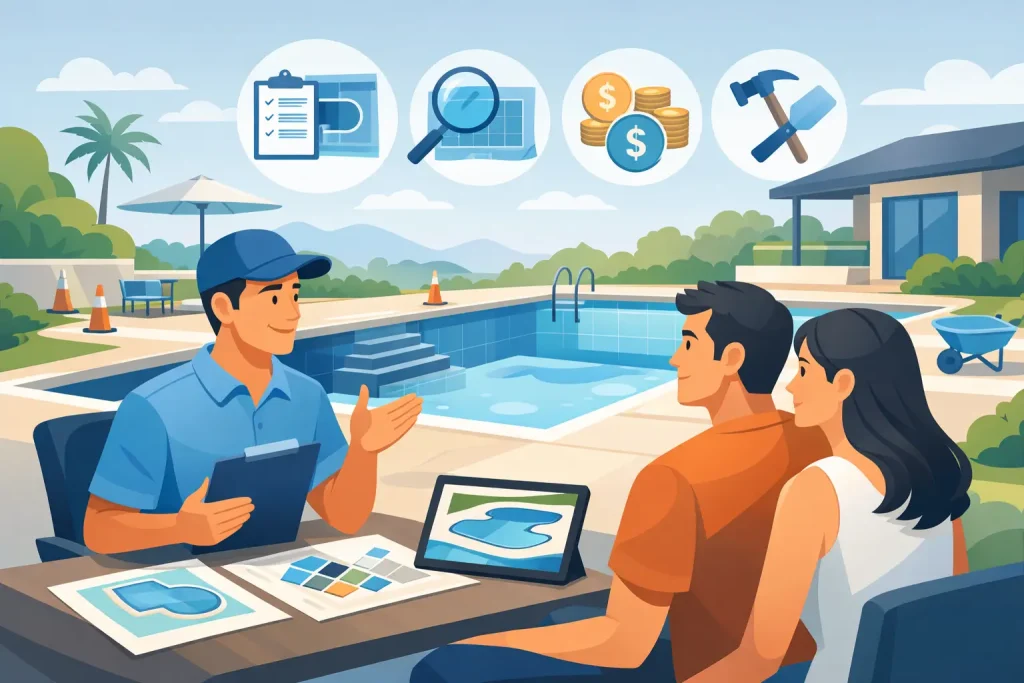
A pool can look straightforward on paper, then become complicated the moment your builder starts talking about access, engineering, permits or site conditions. That is why the right questions to ask a pool builder are not just about price. They are about how the project will actually run on your block, how well the pool will perform over time, and whether the builder can guide the job from concept through to handover without surprises.
In Melbourne and across Victoria, those details matter. Sloping sites, tight suburban access, reactive soil, existing structures and council requirements can all affect what is possible and what it will cost. A good builder should be able to explain these variables clearly, not hide them in vague language or broad allowances.
Why the questions matter before you sign
Most homeowners only build one or two pools in a lifetime. Your builder does it every day. That difference in experience means the conversation needs to cover more than design ideas and finishes. It should test how the builder plans, communicates and solves problems.
The best early meetings are not a sales pitch. They are a fact-finding process. If the answers are clear, specific and backed by experience, you are usually dealing with a builder who understands both the construction side and the client side of the project.
Questions to ask a pool builder about experience and scope
Start with the builder’s core experience. Ask what types of pools they build most often and whether they handle projects similar to yours. A builder who mainly installs standard backyard pools may not be the best fit for a difficult-access site, a compact plunge pool, or a commercial project with stricter compliance requirements.
It also helps to ask whether they manage the full process in-house or rely heavily on outside contractors. There is no single right model, but you want to know who is responsible for design coordination, approvals, engineering, excavation, construction and finishing. Clear accountability usually leads to a smoother job.
If your property has access constraints, retaining walls, limited excavation space or structural considerations, ask what construction methods they recommend and why. This is where expertise really shows. Traditional concrete pools can be an excellent choice for many custom builds, but lightweight panel-built systems can be a smarter solution where access is tight, excavation needs to be reduced, or installation time is a key concern.
What approvals and compliance will you handle?
This question often gets overlooked until a job stalls. Ask the builder exactly which permits, approvals and compliance steps are required for your pool, and who will manage them. Depending on the site and scope, this may involve council considerations, engineering, barrier compliance and other regulatory requirements.
A reliable builder should explain what is included in their service and what sits outside it. If they say they will “help with approvals”, ask what that means in practical terms. Will they prepare documents, liaise with consultants and track progress, or are you expected to coordinate parts of the process yourself?
The difference matters because delays often happen between design and construction, not just during the build itself.
How do you assess site conditions and hidden costs?
One of the most useful questions to ask a pool builder is how they inspect a site before pricing. If a quote is produced without a proper review of access, fall, drainage, soil conditions and nearby structures, there is a higher risk of cost variations later.
Ask what site factors could change the scope. For example, difficult access may require smaller machinery or alternative construction methods. Sloping land may need additional retaining or engineering. Existing services underground can affect excavation. None of this means the project is unsuitable, but it should be discussed early and priced with realism.
A quality-focused builder will not promise that every unknown can be removed. They should, however, be upfront about the major variables and how they manage them.
What is included in the quote, and what is not?
Not all pool quotes cover the same things. Some include only the shell and basic equipment. Others extend to tiling, coping, heating, filtration upgrades, fencing coordination, landscaping interfaces and electrical works. Asking for a detailed inclusions list is essential if you want to compare builders properly.
This is also the time to ask about provisional sums and allowances. If an amount has been estimated rather than fully fixed, find out why. Sometimes that is reasonable, especially where engineering or site works depend on information still to come. The key is transparency.
A cheaper quote is not always better value if large parts of the job are excluded or loosely allowed for.
Which pool construction method suits my site best?
This is where the conversation should become specific to your property. Ask the builder why they are recommending concrete, a lightweight panel-built system, or another method. The answer should be based on your design goals, site constraints, timeline and budget, not just on what they prefer to install.
Concrete offers excellent design flexibility and a premium custom finish, particularly for fully bespoke projects. Lightweight polypropylene panel systems can offer major advantages on sites where excavation needs to be minimised, access is restricted, or structural and insulation performance are priorities. They can also reduce installation time in the right circumstances.
There is no universal best option. A good builder will explain the trade-offs rather than pushing a one-size-fits-all answer.
What equipment do you recommend and why?
The pool itself is only part of the decision. Ask what filtration, sanitation, heating and circulation equipment the builder recommends, and how that choice affects running costs, maintenance and water quality.
If sustainability matters to you, ask about eco-friendly pool systems and energy-efficient equipment. The right setup can reduce water waste, chemical use and long-term operating costs. It is worth discussing insulation performance too, especially if you want to extend your swimming season or improve heating efficiency.
This is also a good point to ask whether the equipment is sized correctly for the pool. Oversized or undersized systems can create issues with performance and cost.
How long will the project take, realistically?
Every homeowner wants a clear timeline, but the most useful answer is not the fastest one. Ask for a realistic program that covers design, approvals, site preparation, construction and final handover. Then ask what can affect that timing.
Weather, permit processing, engineering changes, site conditions and material availability can all shift a schedule. A trustworthy builder will explain where the likely pressure points are. They should also tell you how they communicate updates if the timeline changes.
Good project management is often the difference between a stressful build and one that feels organised.
Who will be my point of contact during the build?
Strong communication is not a bonus in pool construction. It is part of the product. Ask who will keep you informed, how often updates are provided, and who you contact if an issue comes up.
You are looking for a builder who can explain technical matters in plain language and keep decisions moving. That matters even more if the build is happening alongside a renovation, landscaping project or commercial works program.
For many clients, this question reveals a lot. If communication feels unclear before you sign, it usually does not improve once construction starts.
What warranties and aftercare do you provide?
Ask about structural warranties, equipment warranties and what support is available after completion. You should also ask how defects or service issues are handled if something needs attention after handover.
A well-built pool is a long-term asset, so aftercare matters. The builder should be able to explain what is covered, for how long, and what maintenance responsibilities sit with the owner. Clear expectations help protect both sides.
Can you show examples of similar projects?
Past work is one of the strongest indicators of fit. Ask to see pools that match your priorities, whether that is a compact backyard plunge pool, a family pool with custom finishes, a difficult-access installation or a commercial project.
This is also where local experience counts. A Melbourne-based builder who regularly works across varied Victorian sites is more likely to understand the practical issues that affect design, construction and timing. For homeowners wanting a builder that combines custom design with site-smart construction methods, Eco Swim’s experience across concrete, plunge and lightweight panel-built pools is relevant for exactly that reason.
Final questions to ask a pool builder before you choose
Before you commit, ask yourself one more thing: did the builder make the process clearer, or more confusing? The right pool builder should leave you with a better understanding of your options, the likely risks, the realistic cost drivers and the best path for your site.
That is usually the best sign you are speaking with a trusted professional rather than someone focused only on winning the job. A well-built pool starts with good design and quality construction, but it also starts with better questions.