 Skip to main content


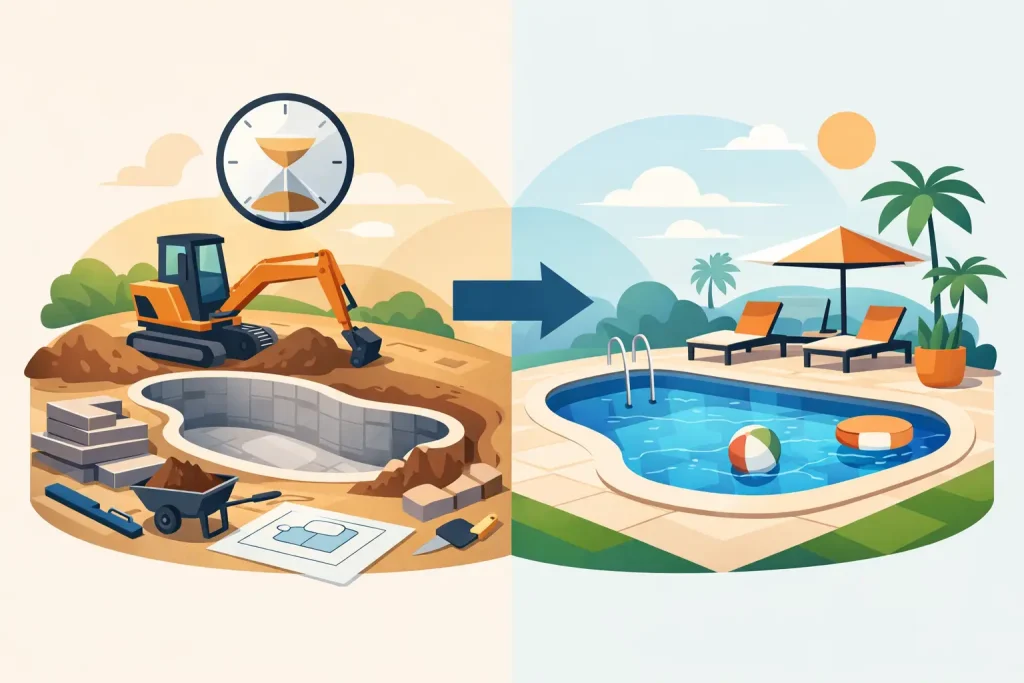
If you are planning a new backyard pool, one of the first practical questions is how long does pool installation take. Fair question. Between permits, excavation, construction and weather, the answer is rarely a simple number – but there is a reliable way to think about the timeline so you can plan with confidence.
For most Melbourne and Victorian projects, pool installation can take anywhere from a few weeks to several months depending on the pool type, site access, engineering requirements and council approvals. The build itself is only one part of the process. In many cases, planning and approvals take longer than the physical installation.
How long does pool installation take from start to finish?
The full timeline usually includes consultation, design, approvals, site preparation, installation, finishing works and handover. If the site is straightforward and the construction method is efficient, the on-site phase can move quickly. If the block is tight, sloping or structurally complex, more time needs to be allowed.
As a general guide, a lightweight panel-built pool can often be installed faster than a traditional concrete pool. That is because it usually requires less excavation, less wet trade work and a more streamlined installation sequence. A custom concrete pool, while highly flexible in design, often involves a longer construction program due to steel fixing, spraying or pouring, curing and finishing.
For homeowners, the key point is this: there is a difference between the total project timeline and the actual time trades are on site. A builder should be clear about both.
What affects how long pool installation takes?
The biggest variable is the pool construction method. Not all pools are built the same way, so they do not move at the same pace.
Pool type and construction system
A concrete pool generally takes longer because it is more labour-intensive and often more customised. It suits fully bespoke designs, unusual shapes and premium finishes, but the extra flexibility usually comes with a longer program.
Lightweight panel-built pools are designed to improve installation efficiency. Advanced polypropylene panel systems can reduce excavation, simplify transport and improve access on sites where machinery movement is limited. That can make a real difference in established Melbourne suburbs where backyards are smaller, access is tight and surrounding structures need to be protected.
Plunge pools can also be quicker than larger family pools simply because there is less excavation, less structural work and a smaller area to complete. That said, a compact site does not always mean a faster job if access is difficult or engineering is more involved.
Site conditions
A flat, open block is easier to work with than a steep or narrow site. Soil conditions also matter. Rock excavation, high water tables, retaining requirements or reactive soil can all extend the timeline.
This is especially relevant across Victoria, where site conditions vary significantly from coastal areas to dense urban suburbs and regional blocks. On some sites, access is the real challenge. If equipment and materials cannot move in easily, the construction sequence needs to be adapted.
Approvals and compliance
Approvals can add weeks or months before any excavation starts. Depending on the location and scope of works, you may need building permits, engineering documentation and compliance with local siting or barrier requirements.
This is one of the most common reasons project timelines feel longer than expected. The pool is not being delayed on site – it simply has not reached the installation stage yet. A quality-focused builder should help manage this process and explain what is required upfront.
Weather and trade scheduling
Weather still affects pool construction, even with efficient building systems. Heavy rain can delay excavation, concrete works, access and finishing trades. Wet conditions also affect surrounding landscaping and site safety.
Trade availability matters too. A well-managed project should be scheduled carefully, but there are still points where specialist trades, inspections or material lead times can influence progress.
Typical pool installation timeline by stage
While every project is different, most installations follow a similar path.
Consultation and design
This stage can take anywhere from one to several weeks depending on how quickly the design is finalised. Factors like pool size, location, finishes, equipment selection and budget all need to be resolved before construction documents are prepared.
If the project includes a difficult site, integrated landscaping or commercial requirements, more planning time is usually needed. That is not wasted time. It often prevents costly changes later.
Approvals and documentation
This can be one of the longer stages, particularly if permits or engineering reviews are required. Some projects move through quickly. Others take longer due to council conditions, additional reports or design revisions.
Homeowners often underestimate this phase because nothing visible is happening in the backyard. In reality, it is a critical part of getting the project ready for a compliant and efficient build.
Excavation and structural installation
Once approvals are in place, site works can begin. On a relatively straightforward job, excavation may be completed in a matter of days. Structural installation then depends on the pool system.
For lightweight panel systems, this stage can be completed more quickly than traditional methods because the structure is prefabricated and assembled efficiently on site. For concrete pools, steel work, shell construction and curing usually take longer.
Services, coping and internal finishes
After the shell is in place, plumbing, filtration equipment, coping, paving interfaces and internal finishes are completed. This stage can move smoothly if the site is accessible and weather cooperates, but it is also where detail matters. Quality workmanship takes coordination.
If the project includes eco-friendly circulation systems, heating, automation or water-saving features, these need to be installed and commissioned properly rather than rushed.
Fencing, compliance and handover
Pool barriers and safety compliance are essential and can affect the completion date if left too late. Final checks, equipment setup and handover also need to be factored into the program.
A professional handover should include operating guidance, maintenance information and confirmation that the pool is ready to use.
Why some pools are installed faster than others
When clients ask how long does pool installation take, they are often really asking whether there is a faster option that still delivers quality. In many cases, the answer is yes – but only if the construction method suits the site and the design goals.
This is where modern lightweight pool technology has changed the conversation. Panel-built systems are not just about speed for the sake of speed. They can also improve access, reduce spoil removal, offer strong insulation benefits and create practical solutions for sites that would otherwise be difficult or expensive to build on.
That matters for properties with limited side access, smaller urban backyards, sloping land or structural constraints. On those sites, an innovative system may reduce disruption as well as shorten the construction timeline.
The trade-off is that not every pool type suits every brief. A fully custom concrete design may still be the right choice where shape flexibility or high-end detailing is the priority. The best builder will explain those trade-offs honestly rather than pushing a one-size-fits-all answer.
How to keep your pool project on schedule
The best way to avoid unnecessary delays is to make decisions early and work with a builder who manages the full process clearly. Delays often come from design changes after approvals, unresolved site issues or poor communication between trades and suppliers.
It also helps to be realistic about what can and cannot be controlled. Weather cannot be managed. Permit response times cannot always be shortened. But a clear scope, proper documentation and experienced project coordination can keep the project moving far more reliably.
For Melbourne homeowners, local experience matters. A builder familiar with Victorian approvals, common site conditions and suburb-specific access challenges is in a stronger position to forecast realistic timeframes from the start.
The realistic answer homeowners need
If you are comparing options, it is better to ask two questions instead of one. First, how long until construction can start? Second, how long will the on-site installation take once it does?
That distinction gives you a much clearer picture of the real timeline. A quality pool build should not feel vague or open-ended. It should be planned properly, explained clearly and matched to the right construction method for your block.
If you want the shortest possible path to a finished pool, the answer is not always to rush. It is to choose a builder and a pool system that suit your site, your goals and your timeline from day one.