 Skip to main content


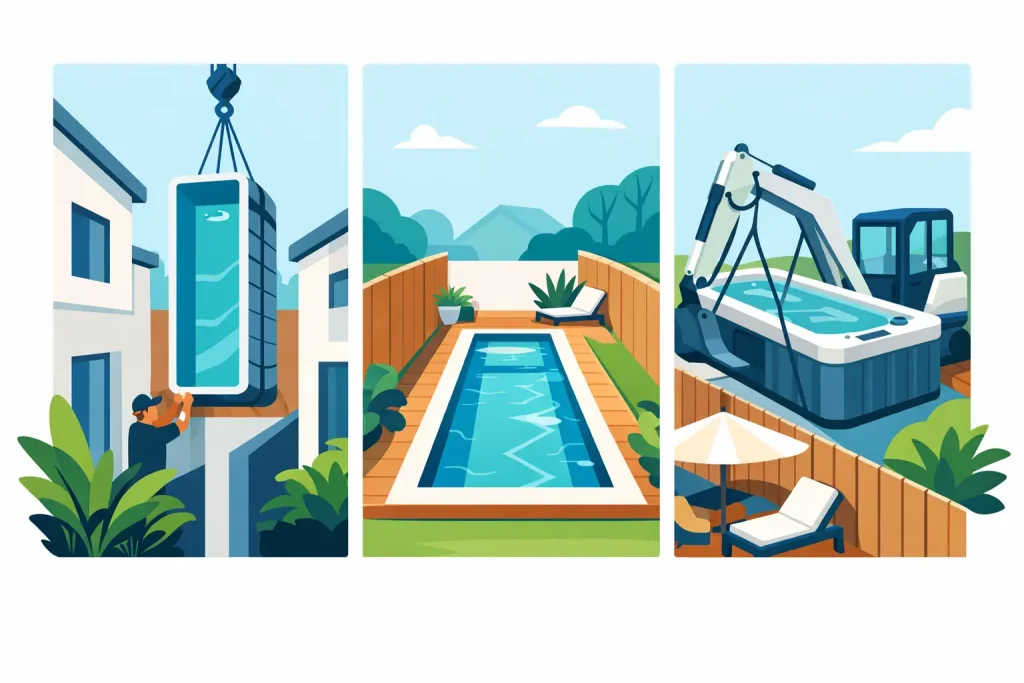
If your block has a tight side passage, overhead powerlines, limited street frontage or no practical way to bring large machinery into the backyard, pool planning changes quickly. The best pool options for narrow access are not always the biggest or cheapest – they are the ones that suit the site, can be installed efficiently and still deliver the finish you want long term.
In Melbourne and across Victoria, narrow access is one of the most common reasons homeowners assume a pool is off the table. In reality, it usually means the construction method matters more than ever. Access constraints affect excavation, soil removal, material handling, installation time and even council planning in some cases. The right builder looks at the whole site, not just the space where the pool will sit.
What counts as narrow access?
Narrow access does not only mean a skinny gap between the house and fence. It can include sloping blocks, tight inner-suburban sites, properties with retaining walls, homes built close to boundaries, or backyards where cranes and large excavators simply cannot get in safely. On some projects, access is technically possible, but only with major disruption to landscaping, fencing or neighbouring property.
That matters because traditional pool construction often assumes there is enough room for heavy equipment, spoil removal and material delivery. When that assumption falls apart, the build method needs to adapt. This is where some pool types perform far better than others.
Best pool options for narrow access on Victorian sites
Not every pool system handles access limitations equally. Some are well suited to compact or difficult sites, while others can become slower, more expensive and more disruptive once access gets tight.
Lightweight panel-built pools
For many narrow access properties, lightweight panel-built pools are the strongest option. These systems use advanced polypropylene panels that can be carried into place in sections rather than delivered as one oversized shell or built entirely through labour-heavy concrete forming.
The practical advantage is clear. Smaller components are easier to move through restricted spaces, which reduces dependence on large machinery and allows greater flexibility on sites with limited entry points. Installation is generally faster, excavation can be more controlled, and there is often less disruption to the surrounding yard.
There is also a performance benefit. Quality panel systems offer strong insulation, durability and design flexibility, making them suitable for custom shapes and compact layouts. For homeowners who want a premium result on a constrained block, this is often the best balance of efficiency and finish.
Plunge pools
A plunge pool is another strong contender when access is limited. Smaller footprints naturally reduce excavation volume, simplify site logistics and suit backyards where every square metre counts. They are especially popular in established suburbs where outdoor space is valuable and full-sized lap pools are not realistic.
Plunge pools work well for cooling off, entertaining and low-maintenance family use, but they do involve a trade-off. If your priority is fitness or giving older children long open swim space, a compact plunge pool may feel restrictive. The design has to match how you will actually use the pool, not just what fits on the plan.
Custom concrete pools
Concrete pools remain a viable option for narrow access, especially when the site or design calls for a fully bespoke solution. Because concrete is constructed in place, it avoids the transport limitations of large preformed shells and can be shaped around difficult boundaries, unusual dimensions or integrated landscaping.
The trade-off is that concrete construction can be more labour-intensive and time-consuming on access-challenged sites. Material handling, steel placement, formwork and pumping all need careful coordination. For some premium homes, that extra complexity is worth it because concrete offers unmatched flexibility in shape, depth and detailing. For others, a modern lightweight system will achieve a similar design outcome with less site pressure.
Small lap pools and courtyard pools
On long, narrow blocks, a slim lap pool or courtyard pool can be the smartest use of available space. These designs are often better than trying to squeeze a conventional rectangular pool into a constrained backyard. They can sit neatly along a boundary, complement an alfresco area and create a strong visual line without overwhelming the site.
Again, access matters. A narrow pool shape does not automatically mean an easy build. The construction method still needs to suit the property. But from a design point of view, these pools are often ideal for inner and middle-ring Melbourne suburbs where width is limited.
Pool types that can be harder on tight-access blocks
Precast fibreglass pools can work on some sites, but they are often more challenging where access is genuinely narrow. The issue is not the pool itself – it is getting a single large shell into place. If crane access is limited or the route to the backyard is obstructed, installation can become complicated and expensive very quickly.
That does not mean fibreglass is always ruled out. Some sites allow crane lifts over the house, and in those cases it can still be feasible. But where overhead clearance, neighbouring structures or site logistics are restrictive, sectional or in-situ construction methods are usually more practical.
What to consider beyond the pool type
Choosing among the best pool options for narrow access is only part of the decision. The site conditions around the pool can be just as important as the pool itself.
Excavation strategy matters because tight sites often require smaller machinery or staged digging. That can influence project timing and spoil removal costs. Soil type also matters. Reactive clay, rock or poor drainage can affect structural requirements and construction sequencing.
There is also the question of where equipment, trades and materials will go during the build. On a narrow-access property, efficient project management is not a bonus – it is essential. A builder needs to think through fencing, neighbour considerations, landscaping protection and the path from front boundary to final installation point.
For many homeowners, one of the biggest surprises is how much easier a project becomes when the pool system is selected with access in mind from the start. Trying to force a construction method onto a difficult site usually leads to delays, added cost or design compromises later.
Why lightweight construction is often the smartest choice
There is a reason lightweight pool technology has become more relevant on modern suburban blocks. Homes are being built closer to boundaries, renovations are reducing side access, and many owners want pools added to established landscapes rather than empty new-build sites.
A lightweight panel system addresses several of these pressures at once. It allows more adaptable delivery and installation, reduces the need for major site disruption and supports tailored pool design rather than a one-size-fits-all approach. It also aligns with the growing demand for eco-friendly construction methods, particularly where recyclable materials and better thermal performance are part of the brief.
For homeowners who want confidence in both the process and the finished result, this combination is hard to ignore. At Eco Swim, this is exactly why lightweight polypropylene panel pools have become such a valuable solution for difficult-access projects across Melbourne.
How to choose the right option for your property
The best starting point is not a brochure or a standard pool size. It is a proper site assessment. A good builder will look at access width, slope, overhead restrictions, existing structures, drainage, soil conditions and how you want to use the pool.
If your goal is a compact, stylish pool for entertaining, a plunge pool or courtyard design may be ideal. If you want a highly customised finish on a premium site, concrete may still be the right fit. If access is especially tight and you want a practical, efficient installation without sacrificing quality, a lightweight panel-built pool is often the standout choice.
This is where experience counts. Narrow access projects do not suit generic advice because small site details can change the recommended solution. The strongest outcomes come from matching the pool type, construction method and layout to the realities of the block.
A difficult site should not force you to settle for a poor design or abandon the idea altogether. With the right planning, the right construction system and a builder who understands constrained access, many properties that seem unsuitable at first glance can accommodate a high-quality pool.
If your access is tight, treat that as a design condition, not a dead end. The right pool is the one that fits the way your site works – and still feels like it was meant to be there.