 Skip to main content


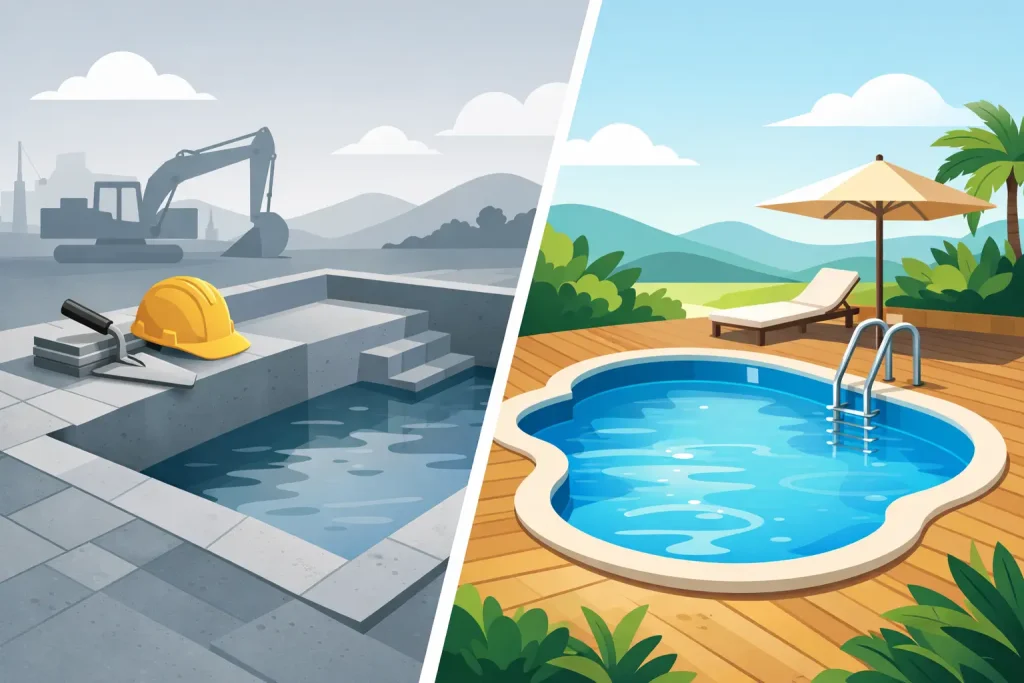
A pool decision usually feels simple until you start looking at your block, your budget and how you actually want to use the space. That is where the real question behind concrete vs fibreglass pools begins. It is not just about appearance. It is about what suits your site, your design goals and the level of flexibility you want over the life of the pool.
For homeowners across Melbourne and wider Victoria, that choice often comes down to more than shell type. Access can be tight, ground conditions can vary, and many backyards need a pool that works around the home rather than the other way around. A pool that looks ideal on paper may not be the best fit once engineering, excavation and installation are factored in.
Concrete vs fibreglass pools: the core difference
The simplest way to look at it is this. A fibreglass pool is a pre-manufactured shell delivered to site in one piece and installed into an excavated hole. A concrete pool is built on site, which allows far more flexibility in size, shape, depth and detailing.
That difference affects nearly everything else, including design freedom, installation method, cost range and how well the pool can respond to challenging sites. Fibreglass is often chosen for speed and simplicity. Concrete is usually chosen for customisation and long-term design control.
Neither option is automatically better. The right answer depends on the priorities of the project.
Design flexibility matters more than most people expect
For many Victorian homes, the backyard is not a blank canvas. You may be working around retaining walls, easements, sloping ground, existing landscaping or a narrow access point down the side of the house. In those situations, standard pool sizes can quickly become restrictive.
This is where concrete has a clear advantage. Because it is constructed on site, it can be designed to suit the available footprint rather than forcing the block to suit a factory mould. If you want a true lap pool, an irregular shape, an integrated spa, a fully customised plunge pool or a pool aligned to a specific outdoor entertaining layout, concrete gives you room to move.
Fibreglass pools come in a range of shapes and sizes, but you are selecting from a catalogue rather than starting with a clean sheet. That can work well for straightforward sites where one of those standard designs fits cleanly. If the site is constrained or the brief is highly specific, those limitations become more obvious.
Installation and site access
Fibreglass is often promoted as the faster option, and in many cases that is true. Because the shell is made off site, installation can move quickly once excavation is complete and the shell arrives. For a property with good access and a suitable layout, that shorter installation window can be appealing.
The challenge is that delivery is part of the equation. A one-piece shell needs enough access for transport and lifting equipment, and that can be a major hurdle on tighter suburban blocks. Overhead powerlines, narrow driveways, neighbouring structures and established gardens can all complicate the process.
Concrete avoids the problem of transporting a complete shell, because the structure is built in place. That can make it more practical for sites with difficult access or structural constraints. It also opens the door to alternative construction methods, including lightweight panel-built systems that reduce excavation demands and improve suitability on complex blocks.
For many Melbourne homeowners, access is not a side issue. It is one of the first things that decides what is possible.
Cost: look beyond the starting price
If you compare base pricing only, fibreglass often appears more affordable upfront. A standard shell with a relatively simple installation can present a lower initial cost than a custom concrete pool. That is one reason fibreglass remains popular.
But the actual project cost depends on much more than the shell itself. Excavation conditions, drainage requirements, site access, retaining works, engineering and surrounding landscaping can shift the numbers significantly. A pool that looks cheaper at the start may become less straightforward once site complications are accounted for.
Concrete generally comes with a higher starting investment, particularly for fully custom designs. In return, you are paying for design freedom, tailored engineering and a structure built around the site. For homeowners prioritising a premium outdoor result, that added flexibility often justifies the spend.
The most useful way to compare cost is not fibreglass versus concrete in isolation. It is total project cost versus the outcome you actually want.
Durability and long-term performance
Both concrete and fibreglass pools can deliver strong long-term performance when they are properly designed, installed and maintained. The difference lies in how they age and what ownership looks like over time.
Concrete is widely regarded as a durable, long-life option. It is structurally strong and well suited to custom engineering requirements. Finishes may need resurfacing down the track, but the underlying structure can offer excellent longevity.
Fibreglass pools have a smooth gelcoat surface that many owners like for comfort underfoot and simpler cleaning. However, the shell is still a manufactured form, and long-term performance depends heavily on product quality, installation standards and ground conditions. Repairs are possible, but colour matching and surface restoration can be more noticeable than some buyers expect.
There is no maintenance-free pool. Water chemistry, cleaning and equipment upkeep still matter whichever construction method you choose.
Concrete vs fibreglass pools for appearance and finish
If aesthetics are a major driver, concrete usually offers more freedom. You can select the dimensions, internal layout and edge details, then pair the structure with finishes that suit the home and landscape design. That allows for a more integrated result, especially on higher-end residential projects.
Fibreglass has improved over the years, and modern shells can look very polished. Even so, the visual outcome is shaped by the mould you choose. Steps, benches and curves are predetermined. That may be perfectly fine for a family pool where practicality is the main priority, but it can feel limiting when the pool is expected to become a central architectural feature.
For homeowners investing in a complete backyard transformation, customisation tends to become more valuable as the design develops.
Which option suits challenging Melbourne sites?
This is where general advice can fall short. Melbourne and regional Victorian sites vary widely, and some of the biggest project differences come from block conditions rather than the pool type itself.
On a flat, accessible site with enough room for delivery and a standard-sized pool, fibreglass can be a practical and efficient solution. It suits clients who want a proven shape, a faster install path and fewer design decisions.
On sloping blocks, smaller urban sites or properties with limited access, concrete often becomes the more realistic option. The same applies where the pool needs to be highly customised or integrated with structural elements such as decks, raised walls or surrounding built form.
There is also a middle ground that many homeowners do not initially consider. Advanced lightweight panel-built pool systems can deliver the custom benefits associated with concrete while reducing some of the excavation and access issues found on difficult sites. For projects where a traditional shell is not ideal, that kind of construction can be a smart, eco-conscious alternative.
So, which pool is right for you?
If you want a straightforward pool on a site with good access, and a standard design meets your needs, fibreglass may be the right fit. It can offer a quicker installation process and a lower entry point for the right property.
If you want a pool tailored to your block, your home and the way you plan to use the space, concrete is usually the stronger option. It gives you far more control over shape, size, depth and finish, and it is often better suited to the realities of Melbourne sites where access and layout are not always simple.
For clients comparing concrete vs fibreglass pools, the best next step is not choosing a material in isolation. It is getting clear advice on what your site can realistically support and what construction method will deliver the result you want without unnecessary compromise.
That is often where the value of an experienced builder really shows. Good advice can save you from designing around the wrong pool type, or overlooking a smarter construction option entirely. If your block is tight, sloping or design-sensitive, asking better questions early can make the whole project feel far more straightforward.