 Skip to main content


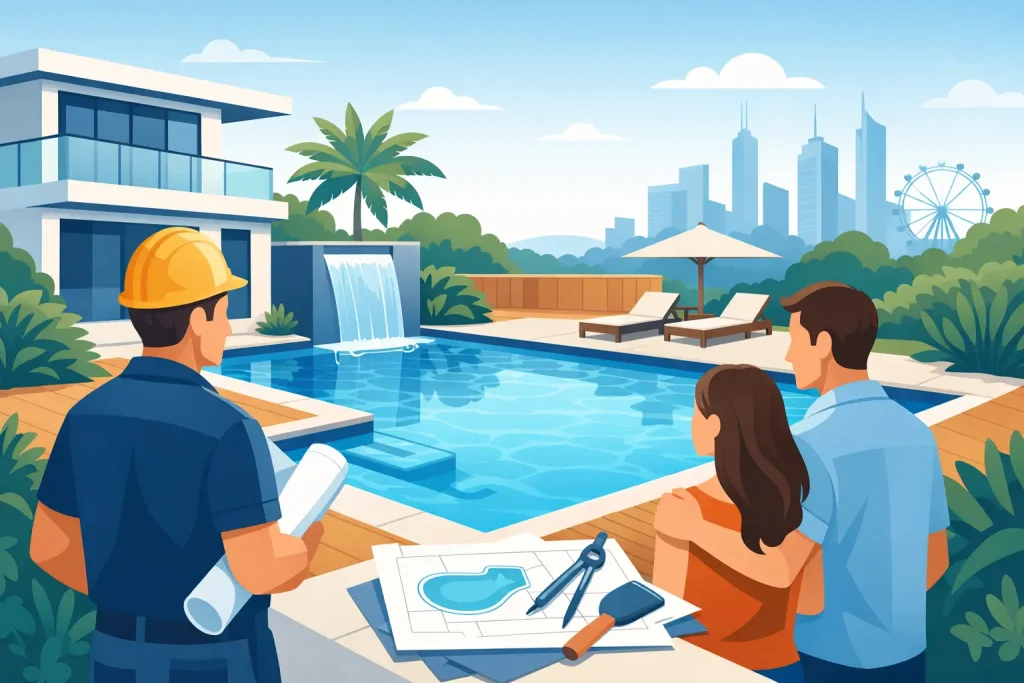
A pool can look straightforward on paper, right up until the realities of your site show up. Tight access down the side of the house, reactive soil, a sloping block, council requirements, or a backyard that needs to work hard for both entertaining and family life – these are the details that separate average contractors from experienced custom pool builders. If you want a pool that suits your property rather than forcing your property to suit the pool, builder selection matters from day one.
In Melbourne and across Victoria, that choice is rarely just about shape or finishes. It is about how well a builder understands design, engineering, approvals, construction methods and site constraints, and how clearly they guide you through each stage. A good custom pool is not only attractive. It is practical, durable and planned properly for the way you live.
What custom pool builders actually do
The term gets used broadly, but true custom pool builders do more than offer a handful of standard shells with a few cosmetic options. A custom approach starts with the site, the brief and the end use. That may mean a long lap pool for exercise, a compact plunge pool for a smaller courtyard, or a larger family pool integrated into a full outdoor renovation.
It also means selecting the right construction method rather than pushing the same solution onto every block. Concrete pools remain a strong option where complete design freedom is needed. At the same time, modern lightweight panel-built systems can be a better fit for difficult access sites, structurally sensitive locations or projects where faster installation is a priority. The best result often comes from a builder who can assess both and explain the trade-offs clearly.
That flexibility is especially valuable in established Melbourne suburbs, where blocks are often irregular, access can be limited, and surrounding structures leave little room for error.
Why the right build method matters
Not every pool should be built the same way. This is one of the biggest points homeowners miss when comparing quotes. Two proposals may appear similar in price or layout, but the construction method behind them can affect excavation requirements, installation time, thermal performance and the overall complexity of the job.
Concrete has long been the benchmark for premium custom design. It is ideal when you want a highly tailored form, challenging dimensions or integrated architectural features. It does, however, involve a more labour-intensive process and can be less forgiving on sites with difficult access or structural limitations.
Lightweight polypropylene panel systems offer a different set of advantages. They reduce excavation demands, provide strong insulation performance and can be particularly effective where site access is restricted. For many Melbourne homeowners, that can mean less disruption, a more efficient build and greater design flexibility on blocks that would otherwise be hard to work with.
There is no universal winner here. The right choice depends on your site, design goals, timeline and budget. A dependable builder will explain where each system performs well and where it may not be the best fit.
Questions to ask custom pool builders before you commit
A builder can have polished imagery and still be the wrong fit for your project. The early conversations should tell you whether they are genuinely solutions-driven or simply quoting quickly to win the job.
Start by asking how they approach site assessment. A proper response should cover access, levels, services, soil conditions, drainage, engineering and compliance considerations. If a builder talks only about finishes and waterline tiles before addressing the site, that is usually a warning sign.
You should also ask who manages the process from concept through to completion. Pool projects involve more moving parts than many people expect. There is design development, approvals, scheduling, excavation, structural work, equipment installation and final handover. Clear project management is not a bonus feature. It is central to keeping the build on track.
It is also worth asking what pool types they build regularly. Some builders market themselves as custom specialists but only operate comfortably within one narrow construction style. If your property has difficult access or your design brief needs a more adaptable system, that lack of flexibility can become expensive later.
Custom pool builders and challenging Melbourne sites
This is where experience really shows. Many Victorian properties are not simple blank canvases. Inner and middle-ring suburbs often have narrow side access, neighbouring structures close to boundaries, existing landscaping worth preserving, or renovation plans that need the pool to fit within a larger design vision.
On these sites, the builder’s problem-solving ability matters as much as their construction skill. A good custom pool builder does not begin by saying no. They begin by working through what is possible, what needs to change and which method gives the best outcome.
For example, a small backyard may be better suited to a plunge pool with careful placement, built-in seating and heating for year-round use, rather than trying to squeeze in a full-size pool that dominates the space. A sloping block may call for a more engineered approach and a builder who is comfortable coordinating structural requirements without losing sight of the finished look.
This is also where lightweight systems can offer a practical edge. Reduced excavation and easier material handling can make a major difference on sites with limited access or conditions that make traditional methods more disruptive.
Design should match how you live
The strongest custom pools do not feel custom just because they look different. They feel custom because they work properly for the household using them. That starts with the questions your builder asks.
If you have young children, safety, shallow-zone usability and easy supervision may shape the layout. If the pool is part of an entertaining area, relationships to alfresco zones, lighting and circulation become more important. If you want a compact pool that is simple to maintain, size and equipment choices should reflect that rather than chasing unnecessary features.
Commercial clients have a different set of priorities again. Durability, compliance, user capacity, maintenance efficiency and programme coordination all become more significant. A builder handling both residential and commercial work often brings a broader technical perspective, particularly on complex or performance-driven projects.
Good design is never just about appearance. It is about balancing looks, construction practicality and long-term use.
Eco-friendly pool building is more than a trend
For many clients, sustainability now sits alongside design and budget as a key decision factor. That does not have to mean compromising on quality or visual appeal. In fact, some of the smartest pool solutions available today combine performance and environmental benefits in a very practical way.
Insulated lightweight panel systems can support better thermal efficiency, which may reduce energy demand over time. Efficient circulation and filtration equipment also help cut running costs. Smart material choices, considered excavation and construction methods that reduce site impact all contribute to a more eco-friendly result.
This matters in Melbourne, where homeowners increasingly want premium outdoor upgrades that also make sense long term. A modern pool should not only look impressive on handover day. It should be efficient to own and sensible to maintain.
That is one reason many clients look for an award-winning, eco-friendly builder with enough technical range to recommend the right system rather than the most familiar one. Eco Swim works in exactly that space, with custom concrete and lightweight panel-built solutions designed around the realities of Victorian sites.
What a good building experience should feel like
The pool itself matters, but so does the way the project is handled. Homeowners often remember communication as clearly as they remember the finished result. Delays can happen. Site conditions can change. Minor adjustments are common in custom construction. What makes the difference is whether your builder communicates clearly, responds early and manages the process with confidence.
You should know what happens next, who to speak to and where your project stands. You should also get honest advice. A trustworthy builder does not promise that every idea is possible at any cost. They explain where compromises may be needed and how to get the best result within your budget and site conditions.
That kind of guidance is especially important if you are building a pool as part of a broader home upgrade. The right builder helps reduce stress because they can see the whole project, not just the excavation footprint.
Value is not the same as the cheapest quote
Pool quotes can vary widely, and the cheapest option is not always comparable. Lower pricing may reflect a simpler scope, limited engineering allowance, reduced finish quality or less experienced project management. None of those issues are obvious if you compare numbers without looking at what sits behind them.
Value comes from fit. The right pool, built with the right method, by a team that understands your site and manages the process well, will usually outperform a cheaper option that needs corrections or compromises later. That applies to residential pools and commercial projects alike.
When you speak with custom pool builders, look beyond the headline figure. Ask how they arrived at their recommendation. Ask what is included, what may vary, and why their construction approach suits your block.
A well-built pool should feel considered from the first conversation, not improvised along the way. If your site is complex, your design brief is specific, or you simply want confidence that the outcome will match the investment, choosing a builder with genuine technical flexibility is one of the smartest decisions you can make.